
An Eclectic Circus
Chapter 25
Fly it from the toppest top
of all the tops
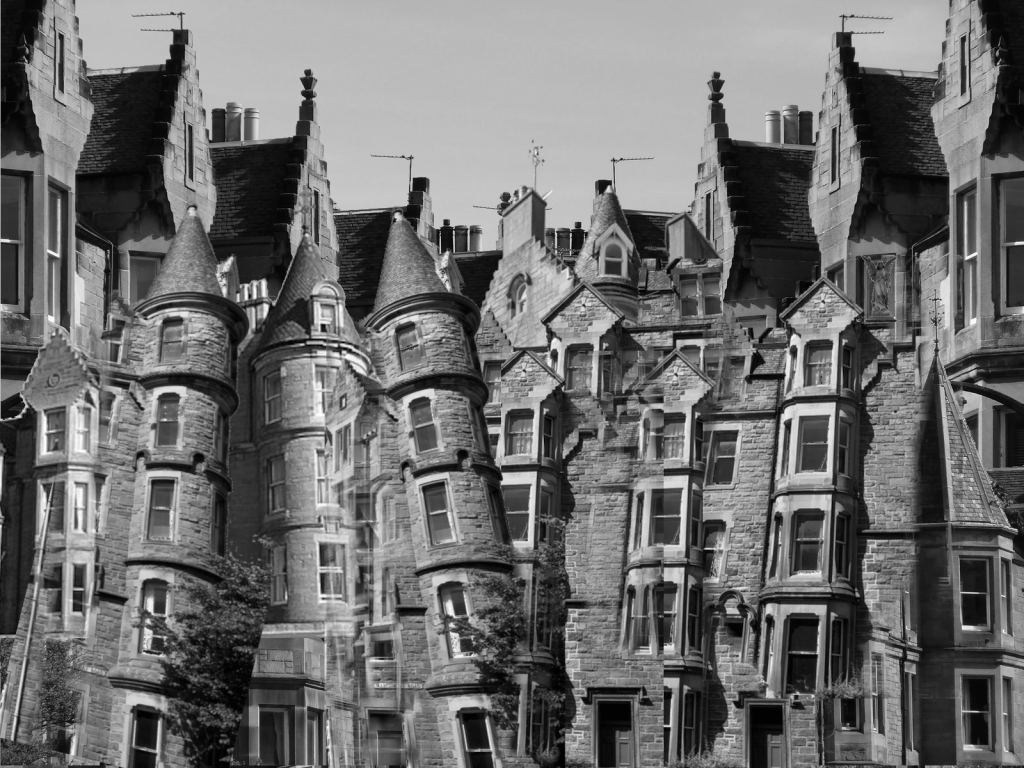
As you come across the Meadows and through the whalebones, you see the Palace of Marchmont in front of you and Warrender Castle on your right.
The Palace of Marchmont is formal, upright, noble, vast. Our few, small rooms are just one part of the main wing. Just one group linked with one stair. We are surrounded by others. Other staircases, other towers, and other chambers forming the main wing. Other wings north, south, east, and west of us.
Warrender Castle is more decorous. Baroque. Flamboyant. Some say flashy. It has its own beauty, its own style. The towers are higher, the rooftops are fancier, the stairs more graceful, the rooms more showy. Go on, take a look. Go in through one of the doors. Climb up one of the stairs and you’ll see.
When they built these places, they built in secret passageways, secret nooks. Extra, unused spaces between the round rooms of the magnificent towers and the more formal, regular rectangular rooms that make up the rest of the dwellings. There were additional staircases that are hidden to most of the inhabitants and connecting doors between many of the rooms that are now closed off. We’ve a couple of those old doorways in our flat. They are shut off so you can’t walk through them. Just presses now. One’s a set of book shelves and another’s a wee cupboard. Pete claims to have walked through Warrender Castle using the hidden stairs, the unknown passages, and the not so well closed off presses. I tried a few stairs in Warrender Castle and the Palace of Marchmont myself, but never got anywhere. Then I tried Spottiswoode.
Not visible at first, sitting between the Palace of Marchmont and Warrender Castle is the smaller, more mysterious Spottiswoode Hall. Less significant and less well-known; like Meadowbank Thistle hiding behind Hibs and Hearts, or Pete Wylie hiding behind Ian McCulloch and Julian Cope, it sits and waits for its fifteen minutes of fame. One quiet Sunday morning, I came back from Bruntsfield a different way and, walking past Spottiswoode Hall, spotted a beautiful stained glass door not far from the House of Usher. Pausing to take a closer look, the door swung open and exposed an ornate spiral staircase rising into the dark building. May as well take a peak, I thought, and went in.
The stair was nicely tiled rather than simple stone. It gave way to entry doors on the first and second floor; however, I climbed to the top and found myself looking down a long passage, brightened by skylights at regular intervals. Walking down to the right, I noticed candle holders fixed to the wall and old used candles within them, overflowing with melted wax drips. I could just about make out another stair at the far end with a delicate metal rail protecting it. I turned to look back on the way I’d come, with the matching, rail-protected stair I’d used behind me. I was half way along the passage. On my left was a door. Not a decorous front door to a property, but a simple functional door like the one on the press in Pall’s room. Thinking I might find some interesting old stuff inside, I opened it, only to find it gave out onto the open air rather than a confined cupboard. I was looking out on a handful of stone steps which, when I climbed up them, reached a small, enclosed space, with stone walls on each side.
I was even more surprised to see that the wall facing me was covered in ivy. A thick, old growth of ivy. I’d not seen anything growing anywhere else on walls in the area. Maybe a small weed up in the rhones above the flats, but nothing of this age and size. My sense of direction told me I was facing east, back towards the Palace of Marchmont, so I guessed this wall gave onto the drying green for this part of Spottiswoode Hall. The wall was about eight or so feet high. Too high for me to see over the top. So I grabbed hold of a thick ivy trunk to see whether it would take my weight and, when I found that it did, pulled myself up to have a gander over the top of the wall.
It was a great view. I had to take my time and enjoy it. Trusting the ivy, I pulled myself onto the top of the wall and sat down, facing east. There was a slab square with a similar drop on the other side of the wall, but I couldn’t see any easy means of climbing back up so I stayed where I was taking in the sights. When you look out over a view like this, you feel like you’ve finally surfaced after living underground. Like when you’re in the Peak District and you’re up on the hills of the Derbyshire Dome you look out over the land and you pity all of the troglodytes still stuck in the dales and the valleys that cut through the rocks below like scars. So it is here. The candle snuffer roofs and the corbie steps and the corbel courses stretch out before me, scarred regularly and evenly by the roads of Marchmont way beneath me.
Here, at last, I can appreciate the true beauty of the roofs. The delicate, intricate filigree swirls and vortices of Warrender Castle’s Mandelbrot turrets like the icing on a collection of fancy wedding cakes. The battalions of stalagmites ranged along the fronts of each wall. Pinnacles of inventive ornamentation like a Brandenburg Concerto. The ordered repetitions of the Palace of Marchmont like chess sets lined up and ready for battle, each pair of royalty flanked by bishops and knights and rooks with each piece attended by its own pawn, simple recurrent rhythmic sequences reminiscent of Bridget Riley or Philip Glass.
This is the majesty of this wonderful place. The toppermost of the poppermost.
 The Ned Wood Archive