
We are used to relegation being decided by brilliant goals on the last day of the season. Or lucky goals, or fantastic saves, or dodgy penalties. For a change, on the last day of this season, the last two relegation places were decided by VAR. And, as PGMOL (Professional Game Match Officials Limited) have admitted, dodgy VAR.
We have already seen the statement from PLMOG (Premier League Match Officials Group) apologising to the relegated teams for the mistakes made by VAR on this season’s final Sunday. We’ve heard from the players and managers on television and on social media. We’ve heard from the pundits, the journalists, and all of those ex-players with an inflated sense of their own importance. Now, let’s hear from the man who really matters: the genius behind VAR himself.
Back in November, we at the Ned Wood Archive were fortunate to meet up VAR’s inventor, VAR man & genius, Marvin Deanius at his office in the Liz Truss Institute for Building Britain Better (Marvin Deanius, VARman, Genius – The Ned Wood Archive). Following the weekend’s denouement, we spoke to Deanius again to find out about the latest VAR developments and to ask him how he felt about incorrect VAR calls being the deciding factor in this year’s relegation battle.
Ned Wood Archive: Good morning Mr Deanius. How are you?
Marvin Deanius: It’s “Sir Marvin” if you don’t mind. I may be a little premature, but I’ve been led to believe that I’ve been awarded a knighthood in the Prime Minister’s resignation honours. So you may as well start using my title now.
Ned Wood Archive: Our apologies. Congratulations. But, which Prime Minister was that?
Sir Marvin Deanius: The last one.
Ned Wood Archive: You mean Liz Truss?
Sir Marvin Deanius: No. The one before that.
Ned Wood Archive: Johnson??!!! OK, well, good luck. I hope you don’t believe anything that he’s told you.
Anyway let’s get down to detail. There were a number of incorrect VAR decisions made on the last day of the 2022/23 football season, decisions that PLGMO (Petty Losers Guessing Match Outcomes) have since apologised for. How do you feel about that?
Plain old Mr Marvin Deanius: It was my finest hour.
The whole point of VAR is to generate controversy and reaction. By getting the calls wrong in most of the critical relegation games, VAR has surpassed itself. People will be talking about this day for years. It’s right up there with the Hand of God and the Russian linesman from 1966. The press can’t get enough of it. You watch, next season, the Premier League will be getting even more attention.
We’ve had calls from the Rugby Football Union, UK Athletics, the England & Wales Cricket Board, you name it. Everyone wants our TV figures. And you folk from your blog wouldn’t be here if we hadn’t had those, shall we say, “interesting” decisions.
Ned Wood Archive: But you are getting the decisions wrong. You aren’t correcting the bad decisions so much as creating more bad decisions.
Marvin Deanius: Yes, that stuff about correcting clear and obvious errors is a smokescreen. VAR is all about taking control away from the referees on the pitch. I must say, it has gone even better than I planned. For one thing, VAR is making the refs worse. We’ve taken away their agency. They are starting to avoid making decisions and are leaving it up to VAR to step in. Same with linos. They won’t flag for offside anymore – they leave it up to us.
Ned Wood Archive: But aren’t they better placed to make the decisions? They are present in the context of the game. They can sense what the players around them think from how they react. I’ve refereed myself. You almost always know instinctively what the correct call is.
Marvin Deanius: You’re missing the point. The whole point of VAR is to take control of the game. We start with a few decisions, the referees get worse, people complain, so we start making more decisions for them. It is a self-reinforcing feedback loop. Soon, we’ll be able to decide the result of every game. Have you also noticed that with VAR we are able to change the laws of the game? Take handball: the written law has all manner of caveats about whether a player handling the ball commits an offence. With VAR, we do away with those caveats and use chance to decide the outcome. Same with offside. An assistant referee looks across the pitch and decides on offside based on the position of the bodies of the players. With VAR we get to decide to use whichever part of the body we want to. Including fingernails and facial hair!
Ned Wood Archive: Do you not think it unfair on the teams involved?
Marvin Deanius: Fairness doesn’t come into it. There has to be some jeopardy, some randomness. That’s what the teams have signed up for. If you don’t like the Premier League, you can just leave. That’s what Brian Clough did in 1993. He was a man of principle. Thankfully, there aren’t that many in football these days.
Ned Wood Archive: You know a lot of supporters think that the system is set up in favour of the top 6 sides. For example, it appears that most of the apologies that PMGOL (Pedantic Marginal Game Observation Lottery) have made have been to Brighton.
Marvin Deanius: Yes, that’s unfortunate. We weren’t trying to make Brighton the centre of attention. Our aim is that the decisions are completely random. It does us no good if people think that one team in particular is the focus of the incorrect decisions. Then it becomes just about them. Do you think Newcastle United or Liverpool fans really care about Brighton? No. Our intention is to make every decision random. Here, let me show you my new invention, one I’ve introduced specifically for this season.
[He throws a handful of dice on the table.]
Ned Wood Archive: Er, those are just dice. Everyone uses them.
Marvin Deanius: No, these are special Random Expected Penalty Indicators (REPIs). We at the Liz Truss Institute for Building Britain Better have the patent on them. Let me tell you how they work. Imagine you are defending and the ball hits your hand. VAR is used to decide whether to award a penalty or not. We roll one of these REPIs.
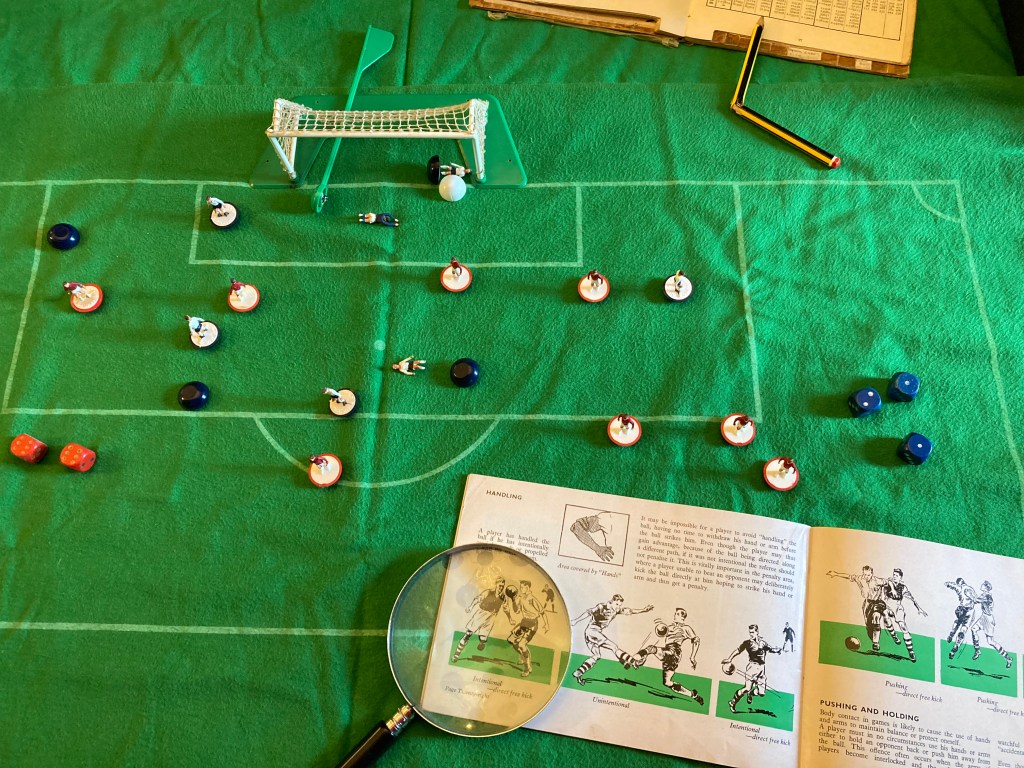
If you are a defender with a top 6 side, then a 6 means it’s a penalty. If the defender doesn’t play for a top 6 side, then a score other than 6 means it’s a penalty. Remember:
- Top 6, must be a 6.
- Not top 6, must not be a 6.
That’s easy to remember and totally fair.
Ned Wood Archive: But you are more likely not to roll a 6. There are more faces on the dice that aren’t 6.
Marvin Deanius: Yes, but there are more Premiership sides that aren’t top 6 sides. It’s perfectly reasonable.
Ned Wood Archive: Another thing. One of the things fans don’t like is that they don’t see the roll of the dice. They just find out the decision.
Marvin Deanius: Now that’s not true. We’ve gone to a lot of trouble to explain our decisions. That’s where this comes in.
[He passes me a few scraps of paper stapled together plus some more dice]
Now roll a couple of these Random Decision Justification Indicators (RDJIs) and use the result to select the page and entry in our Decision Justification Manual. That gives you the justification for the decision.
Ned Wood Archive: They’re dice not Random Whatevers…
Marvin Deanius: Whatever…
Ned Wood Archive: OK, let me have a look at a few of your explanations …. [reading though the justifications in his leaflet…]
- “The area was too congested.”
- “He was supporting himself when he fell and touched the ball.”
- “It’s within the margin of error of our system.”
- “The offside lines were drawn in the wrong place.”
- “The camera’s view was blocked by the assistant referee.”
- “You’re just an uppity little club with a small fan base and an obnoxious wee manager.”
Even these explanations aren’t made available in the ground. We never see the stills. We never see the lines drawn across the pitch. Why’s that?
Marvin Deanius: Do you not have access to television? How are you watching the game?
Ned Wood Archive: I’m talking about spectators actually watching the game live.
Marvin Deanius: ???
Ned Wood Archive: Live. In the stadium.
Marvin Deanius: You mean, not on TV? Nobody does that do they?
Ned Wood Archive: Yes, quite a few of us, actually.
Marvin Deanius: Yes, but not that many, really, not when compared to the global football audience. How many fans does your ground hold? One million? Five million? Ten million? No – well then, that’s way short of the TV audience. How much cash does it bring in per game? Again, way short of the TV cash. Get things in perspective, young man. We are in the business of TV entertainment. We aren’t aiming to provide a service to mugs who want to sit in the cold open air.
Ned Wood Archive: Hmmm. OK. Thankyou for your time, Mr Deanius. One last question. what do you say to anyone who follows, whether in the stadia or on TV, one of the clubs who were relegated by these erroneous VAR decisions.
Marvin Deanius: As I’m sure LPOGL (League of Premier Official Gentlemen and Ladies) will tell you. This isn’t personal. It’s just a matter of luck. Like life.
So there you have it. If your team was one of the unlucky losers in VAR’s weekend of disaster, just remember what the the Football Union for Contentious Knowledge, Wisdom, Insight, and Terrible Suggestions (PGMOL) said: it isn’t personal. You are only a pawn in their game.
 The Ned Wood Archive